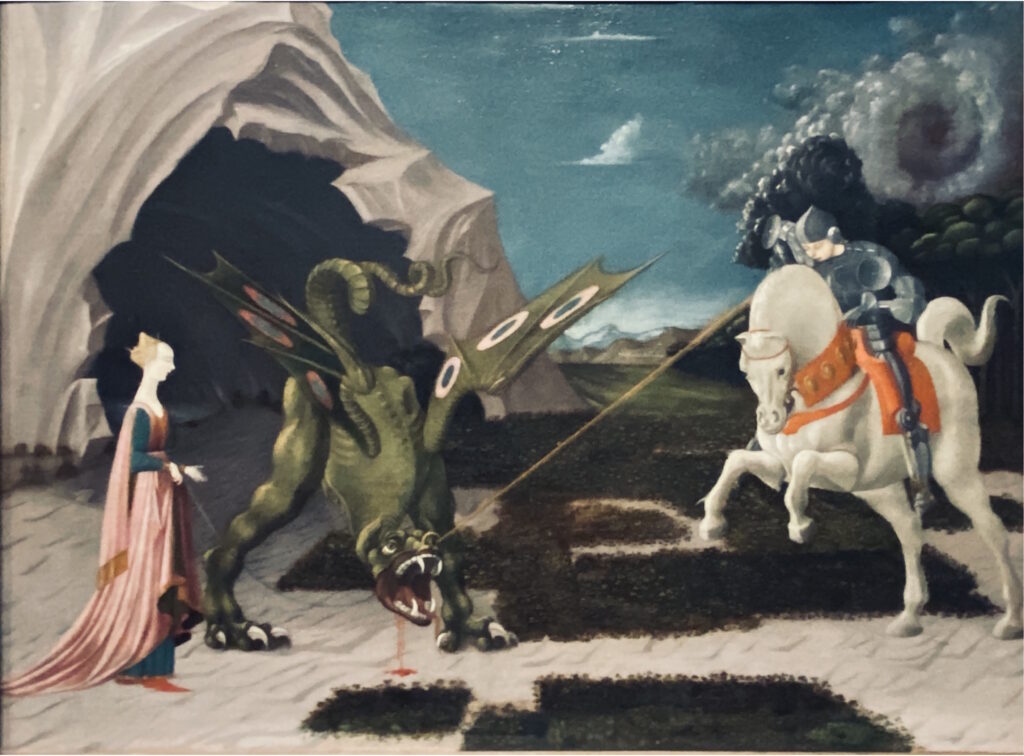
This week’s choice is “Not My Best Side” by U.A. Fanthorpe, which I have chosen to mark a visit to London and a viewing of the painting on which the poem comments.
…I didn’t comment at the time
U.A. Fanthorpe (1929—2009)
(What, after all, are two feet
To a monster?) but afterwards
I was sorry for the bad publicity.
Poem 426. Not My Best Side
I
Not my best side, I’m afraid.
The artist didn’t give me a chance to
Pose properly, and as you can see,
Poor chap, he had this obsession with
Triangles, so he left off two of my
Feet. I didn’t comment at the time
(What, after all, are two feet
To a monster?) but afterwards
I was sorry for the bad publicity.
Why, I said to myself, should my conqueror
Be so ostentatiously beardless, and ride
A horse with a deformed neck and square hoofs?
Why should my victim be so
Unattractive as to be inedible,
And why should she have me literally
On a string? I don’t mind dying
Ritually, since I always rise again,
But I should have liked a little more blood
To show they were taking me seriously.
II
It’s hard for a girl to be sure if
She wants to be rescued. I mean, I quite
Took to the dragon. It’s nice to be
Liked, if you know what I mean. He was
So nicely physical, with his claws
And lovely green skin, and that sexy tail,
And the way he looked at me,
He made me feel he was all ready to
Eat me. And any girl enjoys that.
So when this boy turned up, wearing machinery,
On a really dangerous horse, to be honest
I didn’t much fancy him. I mean,
What was he like underneath the hardware?
He might have acne, blackheads or even
Bad breath for all I could tell, but the dragon–
Well, you could see all his equipment
At a glance. Still, what could I do?
The dragon got himself beaten by the boy,
And a girl’s got to think of her future.
III
I have diplomas in Dragon
Management and Virgin Reclamation.
My horse is the latest model, with
Automatic transmission and built-in
Obsolescence. My spear is custom-built,
And my prototype armour
Still on the secret list. You can’t
Do better than me at the moment.
I’m qualified and equipped to the
Eyebrow. So why be difficult?
Don’t you want to be killed and/or rescued
In the most contemporary way? Don’t
You want to carry out the roles
That sociology and myth have designed for you?
Don’t you realize that, by being choosy,
You are endangering job-prospects
In the spear- and horse-building industries?
What, in any case, does it matter what
You want? You’re in my way.
This poem is a commentary on Paolo Uccello’s painting “Saint George and the Dragon”, an odd work that depicts the conflict between the saint and the monster in a peculiarly anodyne way. It is suggested that Uccello was experimenting with single-point perspective and didn’t get it quite right. The dragon is a peculiar beast, rather triangular and with fewer legs than we generally associate with dragons—more of a wyvern. The princess who was the chosen sacrifice to the monster seems rather detached and already has a thin string round its neck while the saint plunges his lance into its nostril but very little blood is shed.
Ursula Fanthorpe takes the painting as a starting point for three monologues—each of the figures in the painting has their say, and each of their speeches says something about them too.
The first stanza is the dragon’s point of view: it seems to be most concerned about its public image and the possible effect of such a representation on it: the artist is criticised for omitting the dragon’s feet and the saint’s beard, for making the horse look very weird, and for the farcically thin halter that the princess holds around its neck. Since the dragon is a mythical creature, it always reappears, but it’s opinion is that it has been reduced to a comical sidelight rather than a fearsome adversary that should be taken seriously.
In the second stanza, the princess puts her side of the story—she is uninterested in the representation of the painting, being mainly concerned with her future: there’s the dragon which she, at least, seems to be impressed by— “lovely green skin, and that sexy tail”—more so than the saint who she describes as “this boy” who turns up “wearing machinery,/On a really dangerous horse.” However, she is a pragmatist and once the dragon is beaten, “a girl’s got to think of her future” and she accepts the saint who is presumably a knight to remember. She shows a curious ambivalence considering that the saint has rescued her from a dire fate, but her attitude does seem to reflect her stance in the painting.
The third stanza is related by the saint himself who is boastful and arrogant. He brags about his qualifications and his weapons, armour and mount. He seems rather surprised that the princess and the monster aren’t inclined to fall in with his ideas of how they should behave which are very much informed by traditional male-centric views of myth and legend. The frequently-cited endangerment of traditional vocations and crafts is trotted out once again to justify the subjugation of the monster and the miss. In any case, the boy concludes, “You’re in my way” and so it doesn’t matter what they want.
I like this poem because it tells alternate stories, each of which tells us something about the painting and about the legend. I enjoy the contrast between the dragon—“I should have liked a little more blood to show they were taking me seriously”—the maiden, with her laser focus on her own prospects—“a girl’s got to think of her future”—and the saint’s overbearing arrogance—“You can’t/Do better than me at the moment.”
There are several recordings of the poem on YouTube but I like the one by Giles Watson best. There is also a clip of Ursula Fanthorpe discussing poetry which is interesting.
The painting is in room 62 of the National Gallery in London, or it can be viewed on their website. An interesting note on the Wikipedia page for the painting suggests that it may have inspired Sir John Tenniel’s illustration of the Jabberwock (I covered “Jabberwocky” in July 2020).