This week marks the end of the Rubaiyat as the narrator asks us to toast his memory should we ever be present at his grave.
Ah, Love! could thou and I with Fate conspire
Omar Khayyam (1048—1131), translated by Edward Fitzgerald (1809—1883)
To grasp this sorry Scheme of Things entire,
Would not we shatter it to bits—and then
Re-mould it nearer to the Heart’s Desire!
Poem 307. The Rubaiyat of Omar Khayyam, First Edition (Quatrains 59 to 75)
KUZA—NAMA. (“Book of Pots”)
LIX.
Listen again. One Evening at the Close
Of Ramazan, ere the better Moon arose,
In that old Potter’s Shop I stood alone
With the clay Population round in Rows.
LX.
And strange to tell, among that Earthen Lot
Some could articulate, while others not:
And suddenly one more impatient cried—
“Who is the Potter, pray, and who the Pot?”
LXI.
Then said another—“Surely not in vain
My substance from the common Earth was ta’en,
That He who subtly wrought me into Shape
Should stamp me back to common Earth again.”
LXII.
Another said— “Why, ne’er a peevish Boy
Would break the Bowl from which he drank in Joy;
Shall He that made the Vessel in pure Love
And Fansy, in an after Rage destroy!”
LXIII.
None answer’d this; but after Silence spake
A Vessel of a more ungainly Make:
“They sneer at me for leaning all awry;
What? did the Hand then of the Potter shake?”
LXIV.
Said one—“Folks of a surly Tapster tell,
And daub his Visage with the Smoke of Hell;
They talk of some strict Testing of us—Pish!
He’s a Good Fellow, and ‘twill all be well.”
LXV.
Then said another with a long-drawn Sigh,
“My Clay with long oblivion is gone dry:
But, fill me with the old familiar Juice,
Methinks I might recover by-and-bye!”
LXVI.
So, while the Vessels one by one were speaking,
One spied the little Crescent all were seeking:
And then they jogg’d each other, “Brother! Brother!
Hark to the Porter’s Shoulder-knot a-creaking!”
LXVII.
Ah, with the Grape my fading Life provide,
And wash my Body whence the life has died,
And in a Windingsheet of Vineleaf wrapt,
So bury me by some sweet Gardenside.
LXVIII.
That ev’n my buried Ashes such a Snare
Of Perfume shall fling up into the Air,
As not a True Believer passing by
But shall be overtaken unaware.
LXIX.
Indeed, the Idols I have loved so long
Have done my Credit in Men’s Eye much wrong:
Have drown’d my Honour in a shallow Cup,
And sold my Reputation for a Song.
LXX.
Indeed, indeed, Repentance oft before
I swore—but was I sober when I swore?
And then and then came Spring, and Rose-in-hand
My thread-bare Penitence a-pieces tore.
LXXI.
And much as Wine has play’d the Infidel,
And robb’d me of my Robe of Honour—well,
I often wonder what the Vintners buy
One half so precious as the Goods they sell.
LXXII.
Alas, that Spring should vanish with the Rose!
That Youth’s sweet-scented Manuscript should close!
The Nightingale that in the Branches sang,
Ah, whence, and whither flown again, who knows!
LXXIII.
Ah, Love! could thou and I with Fate conspire
To grasp this sorry Scheme of Things entire,
Would not we shatter it to bits—and then
Re-mould it nearer to the Heart’s Desire!
LXXIV.
Ah, Moon of my Delight who know’st no wane,
The Moon of Heav’n is rising once again:
How oft hereafter rising shall she look
Through this same Garden after me—in vain!
LXXV.
And when Thyself with shining Foot shall pass
Among the Guests Star-scatter’d on The Grass,
And in Thy joyous Errand reach the Spot
Where I made one—turn down an empty Glass!
TAMAM SHUD.
This last set of quatrains begins with a digression into the “Book of Pots”—eight quatrains that echo the sentiments of last week’s set, expressing our own doubts and fears as the utterances of clay pots who are ignorant of their maker’s intentions and their own fate, just as we are.
Number 59 sets the scene—the narrator finds himself in a potter’s shop at the end of Ramazan, the Muslim month dedicated to fasting, prayer, reflection and community work, with the shop-keeper’s wares ranged around on shelves.
Suddenly, he becomes aware that some of the pots speak while others are mute, and one of them cries out, peevishly demanding the answer to a question we may pose ourselves: “Who is the Potter, pray, and who the Pot?”—what is the nature of our creator and how is it different from our own?
The next voice poses another interesting question: surely our creator would not spend the effort to make us in all our complex beauty if we were doomed to annihilation and oblivion? Another voice amplifies this idea—would the creator, who presumably made us in a spirit of joy and fancy, afterwards condemn us to destruction like a child who destroys the vessel they were happily drinking from not long before?
There is no answer to this observation and after a pause, a less well-made pot comments that although others mock his awkward shape, this is clearly the intention of the creator, rather than an accident—“What? did the hand then of the Potter shake?”
Another pot speaks of being severely tested by a “surly Tapster” whose face is blackened with “the Smoke of Hell”—this might be a reference to the Devil or perhaps to some judgment in the afterlife; the quatrain finishes with the optimistic assertion that “Pish!/He’s a Good Fellow, and ‘twill all be well.”
The last pot to speak individually laments that its substance is parched from long absence of liquid but that if it were to be filled with the “old familiar Juice”, it would soon recover the glaze and gloss it once held.
With this, the crescent moon is spied, signalling the advent of the Porter bringing new wine to replenish them all, with his shoulder creaking under the weight.
Returning from this digression, our narrator prays that he should be revived with wine when he lies dying and when he has died, his winding sheet should be vine leaves and his burial in a garden so that his ashes shall rise up as a scent to entice those who travel nearby.
The narrator admits that he has lost much in his pursuit of the idols of grape and vine: his honour and reputation have been sacrificed to them cheaply, and he has often sworn repentance of his excesses (as we may all have done) though he is unsure whether these promises also were due to drink and in any case as soon as the opportunity arose, the penitence was shredded anew. He wonders whether, for all that wine has taken from him, what is it the vintners buy that is worth more than their wares—he still values the enjoyment brought by drink above much else.
The next quatrain again laments the transience of youth—“Alas that Spring should vanish with the Rose!”—and likens it to a nightingale that sings in the trees and then departs to some destination unknown.
Quatrain 73 sums up our desire to change the world and remake it as we would wish it to be, and is another quatrain I’ve often used to express dissatisfaction with the life that was forced on me when Nicola died.
The final quatrains in this edition of the poem bring us to a valediction addressed to his beloved: the Moon is rising, but in time she will shine down on others, seeking the narrator in vain, and when his beloved passes through a party of guests “Star-scatter’d on The Grass” and reaches the place he is buried, she should pour out a libation in his memory and “turn down an empty Glass”.
Finally, Tamám shud is a Persian phrase meaning “It is finished”, and so it is.
The last several weeks have been interesting in that I have discovered some facts about the names and places cited in the poem. I have also found several online resources, particularly a set of notes on the Rubiayat taken verse by verse that I intend to read carefully.
I think my first acquaintance with this poem came from Kipling’s “Stalky & Co” where in the story “The Last Term,” Beetle gains the run of the Headmaster’s library and discovers a wide scope of literature:
There were scores and scores of ancient dramatists; there were Hakluyt, his voyages; French translations of Muscovite authors called Pushkin and Lermontoff; little tales of a heady and bewildering nature, interspersed with unusual songs—Peacock was that writer’s name; there was Borrow’s “Lavengro”; an odd theme, purporting to be a translation of something, called a “Ruba’iyat,” which the Head said was a poem not yet come to its own; there were hundreds of volumes of verse—-Crashaw; Dryden; Alexander Smith; L. E. L.; Lydia Sigourney; Fletcher and a purple island; Donne; Marlowe’s “Faust”; and—this made McTurk (to whom Beetle conveyed it) sheer drunk for three days—Ossian; “The Earthly Paradise”; “Atalanta in Calydon”; and Rossetti—to name only a few.
The Last Term from “Stalky & Co.” by Rudyard Kipling.
The idea of “a poem not yet come to its own” was intriguing and I eventually found a book about it in my local library, and loved it instantly, so much so that I copied it out by hand.
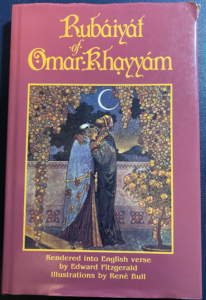
Since then I have obtained a number of copies including a Kindle version which has been helpful while writing these articles and when I visited Alnwick last year, I was delighted to find a hardback edition in Barter Books which I immediately bought “for a song” as the poem has it. It is gorgeously illustrated and worth everything I paid for it.